The Biography of Zygmunt Pergricht, Sosnowice
Short biography and stations of his persecution
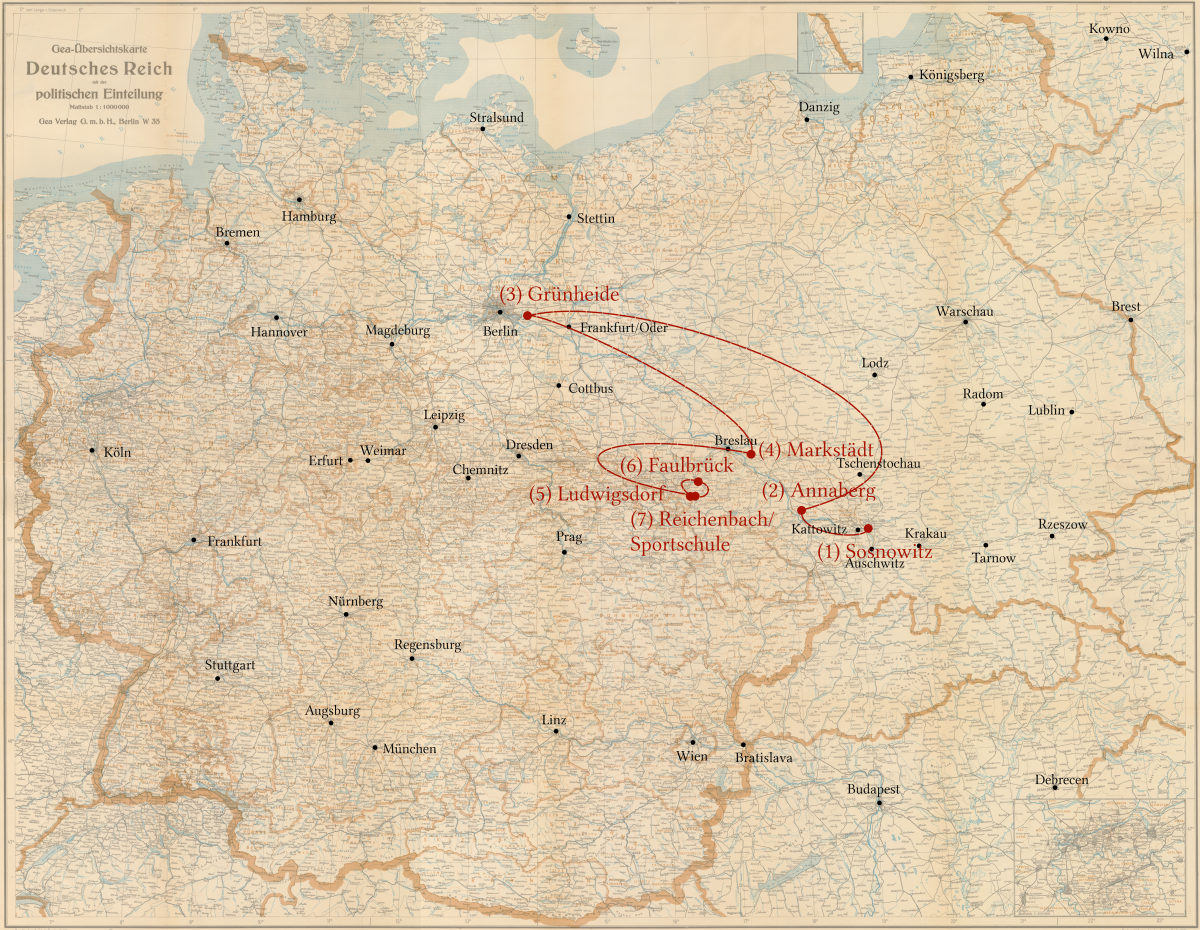
- born on 12 December 1924 in Sosnowice/Poland
- April 1940 to April 1941 Annaberg forced labour camp
- April 1941 to the end of 1942 Gruenheide forced labour camp
- End of 1942 to beginning of 1943 Markstädt forced labour camp
- Beginning of 1943 to July 1944 Groß-Rosen/Ludwigsdorf concentration camp
- July 1944 to September Faulbrück forced labour camp
- September 1944 to 8 May 1945 concentration camp Groß-Rosen/Langenbielau ("Reichenbach/Sportschule")
- 8 May 1945 Liberation
- Poland
- 7 November 1946 Ulm Displaced Persons Camp
- Schwäbisch-Hall Displaced Persons Camp
- 23 May 1949 Israel
Zygmunt Pergricht was 15 years old when he was sent to a forced labor camp. Nothing is known about the fate of his family.
Sosnowitz
I was born on 12 December 1924 in Sosnowieccz, Poland. My parents' names are Dawid and Rywka, née Lustiger. At the outbreak of the war, in September 1939, I lived in Sosnowiec (Poland) Katarzyma Str
Annaberg, Grünheide
In April 1940, the German occupation authorities ordered me from my home town of Sosnowiec to ZAL Annaberg. I was forcibly employed there doing forestry work. We were housed in a camp surrounded by barbed wire and guarded by the Wehrmacht. I lived in barrack no. 3; the camp leader was called Lehmann, an SA man. In April 1941 I was transferred to ZAL Gruenheide, where I worked for the R.A.B.. Here, too, we lived in a camp surrounded by barbed wire and guarded by the SA. The camp leader was called Drobek. I lived in wooden barrack no. 1.
Statement by Zygmunt Pergricht, 7 Dec. 1953, file Pergricht, Zygmunt, Bü 51175/S. 2
One day during roll call in Grünheide I was taken out of line - I still don't know the reason - and tied to a tree and beaten terribly by the guard Antonin Pietscheck until I fell unconscious. After this mistreatment, my strength was already failing and I was constantly afraid of further beatings.
Statement from 17.3.1960
I met the claimant, Mr Zygmunt Pergricht, at ZAL Annaberg. At that time he was still completely healthy and fully able to work. He was also still healthy at the beginning in ZAL Grünheide. It was only here, due to the hard forced labour, the hardships, the hunger and the cruel mistreatment, that his health was shattered. I was an eyewitness one day when he was tied to a tree and beaten mercilessly with a truncheon by the guard Antonin Pietscheck until he fell unconscious.
Statement by Sara Gluecksman, 7 Dec. 1953, file Pergricht, Zygmunt, Bü 51175/S. 23
| Forced labour camp for Jews in Silesia | |
| Place | Góra Świętej Anny / Sankt Annaberg |
| Territory | Prussia (Province of Upper Silesia) |
| Opening | November 1939 |
| Closure | The exact date of evacuation cannot be determined; some of the prisoners were "evacuated" to Auschwitz II (Birkenau) concentration camp and arrived there on 30 September 1944; liberation took place in January 1945 |
| Gender | Men |
| Employment of prisoners at | OT; Oderthal-Werke, Graf Schaffgotsch (factory for synthetic petrol); Rosner company, uniform tailoring; ALTANA (meaning of abbreviation not known), carpentry; Lenz company; Rösner u. Sohn; Moser u. Kallenbach |
| Type of work | Shaft, civil engineering and clearing work after bombing of the plant, construction of the Reich motorway Breslau-Kattowitz |
| Remarks | In June 1941, the prisoners were transferred to other smaller camps in order to free up the camp for Russian prisoners of war. About a year later, Jewish prisoners were again sent to the forced labour camp for Jews. From December 1941 to June 1943, the camp was used to accommodate sick people from the surrounding forced labour camps for Jews |
| Source: deutschland-ein-denkmal.de | |
Markstädt, Ludwigsdorf
After about 1 1/2 years, it was the end of 1942, I was transferred to ZAL Markstaett (note: Markstädt). My workplace there was at the Gruen & Bilfinger company; I was employed in a transport column on the building site.
Statement by Zygmunt Pergricht, 7 December 1953, file Pergricht, Zygmunt, Landesarchiv-Baden-Württemberg, Abt. Staatsarchiv Ludwigsburg, EL 350 I, Bü 51175
At the end of 1942 we were sent to ZAL Markstaett (note: Markstädt), where we were forcibly employed by the Gruen & Bilfinger company. The camp was surrounded by barbed wire and strictly guarded by the SA. We worked in transport at the construction site.
Statement by Dawid Gluecksman, 7 Dec. 1953,,File Pergricht, Zygmunt, Landesarchiv-Baden-Württemberg, Abt. Staatsarchiv Ludwigsburg, EL 350 I, Bü 51175
At the beginning of 1943 I was sent to Ludwigsdorf concentration camp, where I was employed in an ammunition factory.
One day in Ludwigsdorf I was caught with two potatoes when I returned to the camp from work, and I was punished with 120 strokes. I was taken into the wash barrack and hung up there with my feet up and then beaten with a rubber truncheon. I received 80 blows. After that I was covered in blood and unconscious. I only woke up in the infirmary. Eyewitnesses told me afterwards that I was left hanging all night and was only taken to the infirmary the next day.
Statement by Zygmunt Pergricht, 7 December 1953, file Pergricht, Zygmunt, Landesarchiv-Baden-Württemberg, Abt. Staatsarchiv Ludwigsburg, EL 350 I, Bü 51175
In Ludwigsdorf I was employed in the laundry barracks. One day he was taken to this barrack as a punishment because two potatoes had been found on him, and he was hung up by his feet and given 80 lashes with a cane. He was covered in blood. He was left hanging like that for a long time and was only taken to hospital the next day.
Statement by Sara Gluecksman, 17 March 1960, Konrad Kittl files
Faulbrück, Reichenbach
I stayed here until July 1944 and was then sent to Faulbrueck concentration camp, where I was put to work for the Telefunken company. After about 2-3 months, it may have been September 1944, I came to Reichenbach, where I was imprisoned in the sports school. I also worked for the Telefunken company during this period of imprisonment; we were guarded by the SS. I was liberated by Russian troops in Reichenbach on 8 May 1945.
Statement by Zygmunt Pergricht, 7 Dec. 1953, file Pergricht, Zygmunt, Bü 51175/S. 25
In the summer of 1944 I was sent to the Faulbrück concentration camp together with the above-mentioned, where I was employed as a mechanic by the Telefunken company; the above-mentioned also worked for the same company. In August or September 1944, we were evacuated from the Faulbrueck concentration camp to the Reichenbach concentration camp, where we were housed in the sports school. I worked for the Tietz company as a car mechanic, while the aforementioned was employed by the Telefunken company. We were liberated together in Reichenbach on 8 May 1945.
Statement by Zygmunt Pergricht, 7 December 1953, file Pergricht, Zygmunt, Landesarchiv-Baden-Württemberg, Abt. Staatsarchiv Ludwigsburg, EL 350 I, Bü 51175
.
| Subcamps of the Groß-Rosen concentration camp | |
|---|---|
| Location | Bielawa I / Langenbielau I |
| Name | "Reichenbach Sports School" |
| Area | Prussia (Province of Lower Silesia) |
| Opening | First half of 1944, previously a forced labour camp for Jews |
| Closing | Liberation on 8 May 1945 |
| Gender | Men |
| Employment of the prisoners at | Siling I (former Christian Dierig AG weaving mill); Siling II (former Jordan weaving mill); Zill & Knebich; Hansen & Neumann; Lehmann company; G. F. Flechtner company, spinning mill; Telefunken company; Krupp (former Meyer Kauffmann factory); Fa. Rebich, Schweidnitz; Richter & Schädel, log cabin construction; "Preschona" aircraft factory; Goldschmidt; Hagenuk, radio factory (Hanseatische Apparatebau Gesellschaft, formerly Neufeldt & Kunke, Kiel) |
| Type of work | In addition to being deployed at companies, the prisoners were also used for entrenchment work |
| Source: deutschland-ein-denkmal.de | |
Notes
Further Sources
Akte , Landesarchiv-Baden-Württemberg, Abt. Staatsarchiv Ludwigsburg, EL 350 I, Bü 51175
Office for Compensation
Stuttgart
Notes
---
Picture Credits
---